
Climate Matters 154
Scenarios, scenarios, and scenarios, plus a double shout out, and more (and now with the ROE item added!)

Firstly, a big thanks to everyone streaming the Front-footing the Future series - Fresh FM report it topped their streaming last month, no mean achievement for such a serious topic. AND, watch this space - we’re so impressed with the content from our expert guests that we’re exploring other ways to make it available to as wide an audience as possible.
Secondly, it’s the turn of “scenarios” to feature in my inbox, and we report on three very different approaches - all are important, all require, and deserve, concentration.
Here’s what’s in CM 154:
Mind-boggling achievements by Carbon Brief and Dr Kevin Trenberth
Quick report on The Reality of Everything Symposium [now included]
A “recipe for food insecurity” in our region
Interview with the remarkable Dr Christina Hood
Scenarios take 1: Scenarios for Aotearoa New Zealand
Scenarios take 2: Uphill Futures in a Downhill World
Scenarios take 3: The quest for the Hope Attractor
Interview with the exceptional systems analyst Nathan Surendran
US Strong Towns gives a surprising nod to NZ’s Infrastructure Plan.
Double shout out - Carbon Brief and Dr Kevin Trenberth


Big shout out to Carbon Brief for their astonishing “Project Cosmos” work in synthesising 1.8 million climate publications. And a big shout out to Dr Kevin Trenberth, seventh among the 500 most-cited climate academics in Cosmos.
“At number seven, with a citation score of 45,751, is Dr Kevin Trenberth – a “distinguished scholar” at NCAR and an honorary academic in the department of physics in New Zealand’s University in Auckland.
Trenberth has held many senior positions, including as chair of the World Climate Research Programme’s observation and assimilation panel and global energy and water exchanges scientific steering group.
Trenberth has also been a lead author on multiple IPCC reports.”
To our great good fortune, he is also a thought leader at Newsroom.
The reality of the Reality of Everything Symposium.
Big apologies for failing to insert this in the first edition. 26th June saw a full house for this impressive and ambitious event – big kudos, especially to Catherine Knight. I got heaps out of it, with expert presenters delivering tight presentations, and an intriguing dip into deliberative democracy platform Pol-is (watch this space).
Billed as similar to the UK’s “National Emergency Briefing,” I was expecting a little more punch, and it was maybe a touch too climate-focussed for “everything.” Mike Joy was my stand-out presenter: “GDP is the best indicator of environmental harm.” And everyone with colonial connections should take stock of Mahina-a-rangi Baker’s salutary messages. The ROE is clearly intended as the start of a process rather than a lone event, and I’ll follow/join in with enthusiasm and try to keep you posted.
“Recipe for food insecurity: war, fertiliser, and the El Niño”
The Australian Security Leaders Climate Group has just released the above report . “The war on Iran has already disrupted around one-third of global fertiliser supplies.” they note. Add in the further impact of a Super El Niño on food production, and “The risks extend beyond supermarket shelves. Food insecurity could trigger wider economic disruption, humanitarian crises and instability across our region…”
This feels like yet another national discussion we should be having but are not - rather like the UK government trying to withhold their dire January National Security Assessment. Chances are we’ll take an “I’m okay” approach like we have with fuel prices, and ignore the awful consequences on poorer areas of the world when we outbid them for supplies that are existential for them but just optional for us.
“We still underestimate cascading systems risks.” Simon Millar, right on point, commenting on the 2026 Agriculture and Climate conference. (See next CM, 155, for the interview).
Front-footing the Future Interview with Dr Christina Hood
Christina is the chief climate advisor to the New Zealand Climate Foundation, and is a former climate lead with the International Energy Agency. In this conversation she traverses climate policy, the ETS, energy, the importance of independent technical advice to government , the electricity sector’s structural operation and wholesale pricing, the International Court of Justice 2025 opinion, and much more.
You’ll find more details on the series here, and can hear full and condensed interviews in various places, including streaming on Spotify.
Scenarios take 1: Future Scenarios for Aotearoa New Zealand
Futurist Victoria Mulligan will be a guest on Front-footing the Future late in July. Meantime do visit her website and, especially, check out her thought-provoking ”Scenarios for Aotearoa New Zealand”. This is an important initiative promoting discussion of key issues and options, and how they might affect our future.
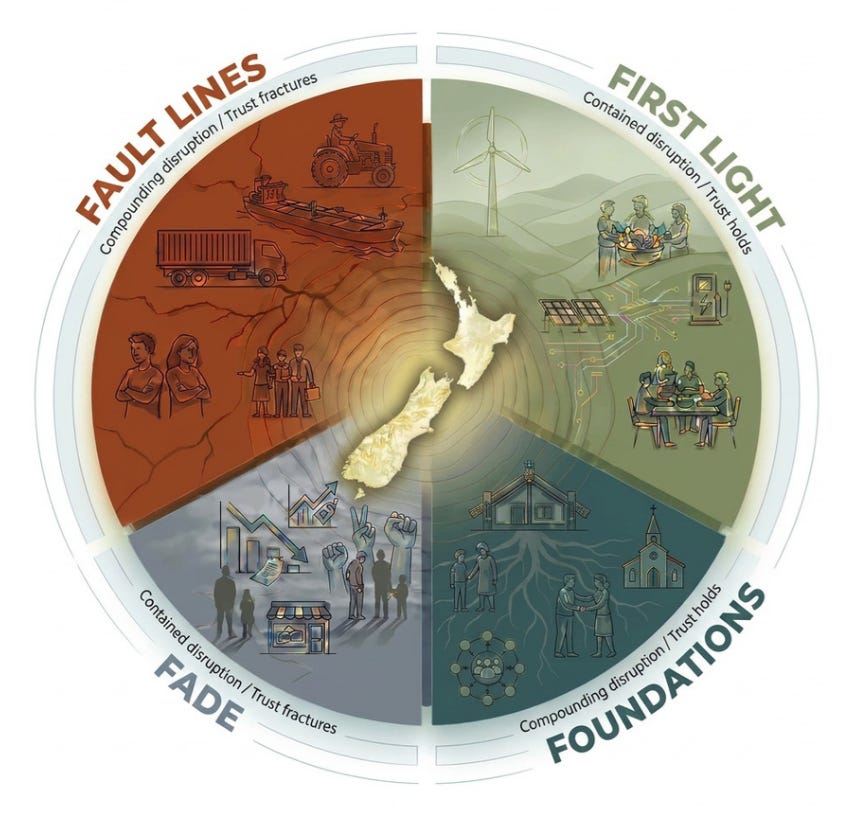
And if this idea resonates with you, or you are just curious, give serious thought to joining the Zoom session with Victoria on 31st July - info and registration here.
Scenarios take 2: Uphill Futures in a Downhill World
We’ve mentioned before Nate Hagen’s “how to think about the future” podcasts (episodes 138, 139, 145 and … of his ongoing “Frankly” series ). I particularly encourage you to watch 145, “Uphill Futures in a Downhill World,” in its own right, as part of a significant series, and as a bridge between Victoria Mulligan’s work and the eyewatering “Hope Attractor” in Scenarios Take 3.
A simple take-away from a complex sweep of information is that, to get to a survivable state, we must shun the easy options, and work hard to get out of our doomed “valley” and over the ridge into a valley offering better futures.
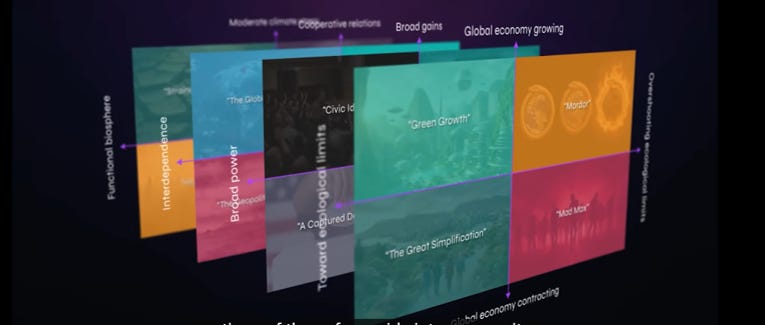

Scenarios take 3: the eye-watering quest for the Hope Attractor
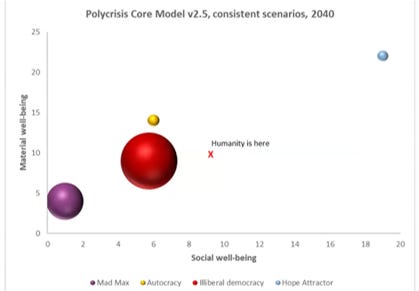
The Cascade Institute has devised pioneering developments of already-eye-watering forms of systems analysis to assess the options for getting from “here” to “there” - from where we are at present to acceptable and stable future conditions. Adapt Research explain that Cascade’s researchers, using 2040 as a target, and with an intriguing matrix of inputs into an 11-dimensional model, computed over 4 million future scenarios of which only eleven offered reasonable stability. And those eleven coalesced into a few “major attractors” as below, with only the “Hope Attractor” (blue orb, top right) offering a stable, liveable (but still very hot) future. (The two elevens are numerical coincidence.)
Intrigued? Check out this 60 minute candid explainer on YouTube.
Front-footing the Future Interview with Nathan Surendran
Nathan, energy expert, systems analyst, wide-boundary-thinker and more, unpicks a wide range of energy-related issues from “middle distillates” to the ethics of fuel pricing.
Strong Towns gives NZ’s new infrastructure plan a nod
I’ve long been a fan of US-based urban planning group Strong Towns, and under the banner “What do we count as progress?” their 30th June post lamented “So why does it feel like we’re always building something new while struggling to take care of what we’ve already built?” Sound familiar?
After linking the US malaise to enduring post WW II expansionist policies, they give a generous and insightful nod to NZ’s National Infrastructure Plan: “New Zealand has written a national infrastructure plan that starts with the understanding that every piece of infrastructure is a promise to future generations. It acknowledges that, before making new promises, you have to keep the ones you’ve already made, which requires real money, effort, and discipline.”
From their track record on climate, it’s hard to believe the present government understands the idea of “a promise to future generations.” But Minister Chris Bishop’s outline of the government’s response, here, seems to take at least some of it seriously.
(Sorry - the link to the Strong Towns post is broken)
A thought-provoking quotation from the world’s most-cited climate scientist:
“I’m very concerned, because we have been trying to simulate for, like with the IPCC Earth-system models, gradual changes. So, there is slowly higher CO2, the trees take more carbon. There is a rise of temperature, little bit more extremes, and sometimes the plants and the oceans are affected.
But what we are seeing more and more is abrupt changes. Like you have a hot summer in 2023 in Canada and 11% of the boreal forest is burnt and releasing CO2. We have a massive drought in the Amazon and trees can die in the elapse of one or two years. We have heatwaves in Siberia and we see that all these permafrost frozen ground is collapsing in one year.
So, all those abrupt change processes, when you measure them locally, you see very big carbon losses. And the big problem is that, in the field, we see that they are very dangerous, but, in the IPCC models, they don’t exist… this asymmetry of knowledge is a big problem, because you could argue that we are, perhaps, over-optimistic by underestimating, or not looking at the carbon loss processes.”
Professor Philippe Ciais, in an interview with Carbon Brief.
Your CM editions are always such rich pastures of knowledge and wisdom to graze on, with the Front-Footing interviews taking it to a new level. I’m so much enjoying this. Thank you for enriching our lives!
Excellent stuff Lindsay! This is a vital round-up of some great material.