
Climate Matters 152
Climate policy interviews, here we come! And much more.

It’s exciting to release the first two interviews in our Front-footing the Future series, aimed at getting our climate policy fit for purpose. You can directly stream full interviews with Professors Jonathan Boston (policy guru) and James Renwick (climate scientist), access condensed radio versions, stream on Spotify and Apple, and link to the Resilienz webpage for the full schedule, guest bio notes - explainer below.
But climate issues don’t pause for our series, so here’s what’s in CM 152:
A guide to listening to the “Front-footing the Future” series.
How cool to be cool - a movement of its time
Full audio of interview with Professor Jonathan Boston, climate policy guru
The same only different: more nitrogen where it’s not wanted
“Kiwis in Climate”, an important book from Kiwis In Climate.
Full audio of interview with Professor James Renwick, climate scientist
A Goon Gong for finance minister Nicola Willis
Watch this space! Official advice on what the government should be doing
A hotter tip for a cooler planet - easy and free!
A quest for “Anthropocene Intelligence” in university education.
Ways to listen to Front-footing the Future podcasts.
Interviews on “Front-footing the Future: Getting our climate policy fit for purpose” will be released weekly between now and the 2026 New Zealand general election.
They will be released in full (40-60 min) and condensed (20-25 min).
Full interviews will go out in pairs in the first Climate Matters after their release date (just like below, paired because interviews are weekly but CM is fortnightly). They will then be streamed on Spotify and Apple.
Condensed interviews will be broadcast across Christchurch and Canterbury (Plains Media), the Top of the South Island (Fresh FM), the Wairarapa (Arrow FM) and Hamilton and the Waikato (Free FM), and will be streamed on Fresh FM, Spotify, and Apple.
More info on the full series and guests can be found on the Resilienz website.
If you like the idea of this podcast series please make it easy for others to follow.
How cool to be cool - a movement of its time
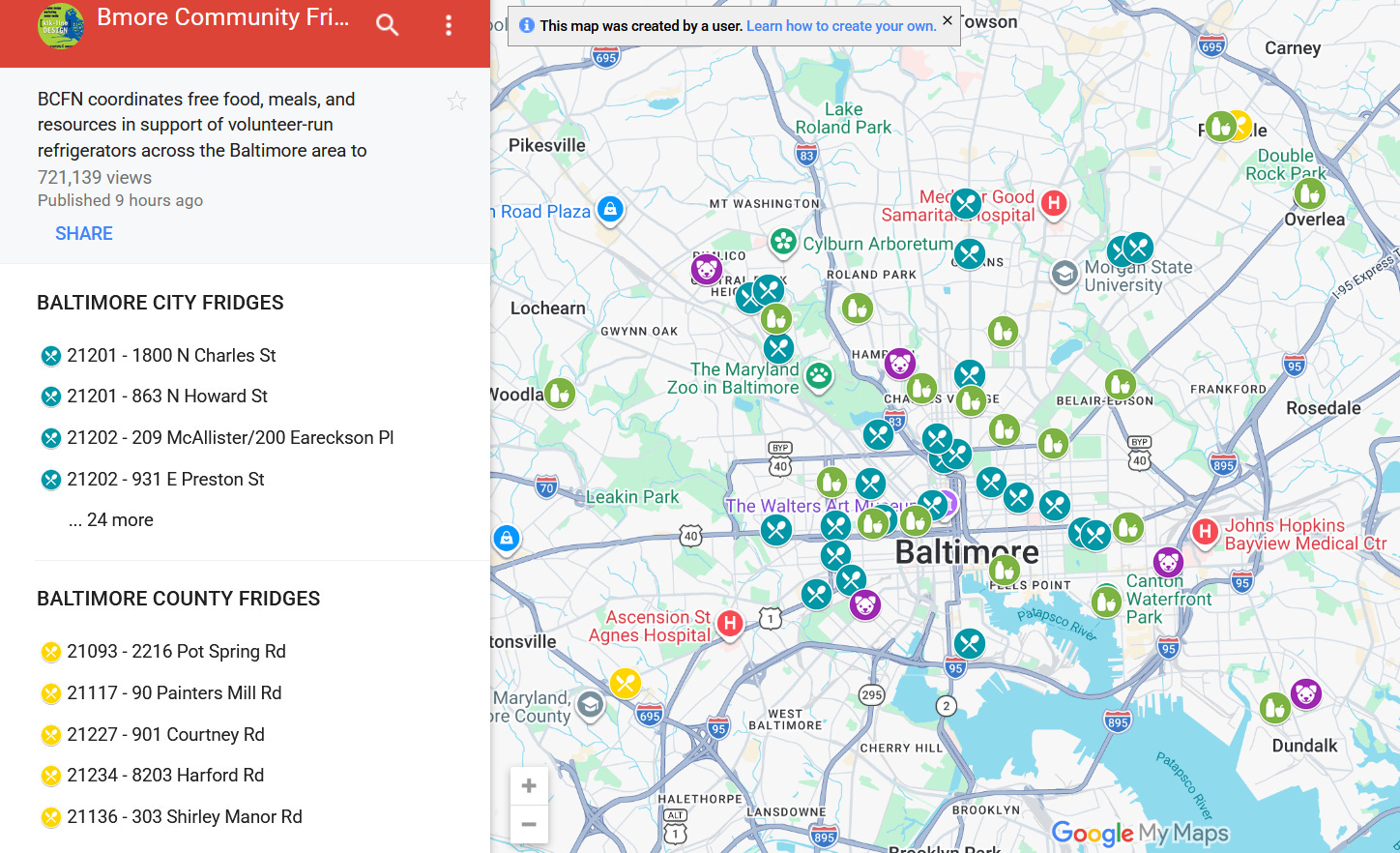
The BCFN, or Baltimore Community Fridge Network, is one of many such networks emerging in a time of increasing need, “fighting food insecurity one fridge at a time.” (See article here). Baltimore reports an awful, but all too familiar, 28% of families dealing with food insecurity.
Locals keep tabs on fridges near them, checking they are clean and tidy. Of course there needs to be a power supply with payment arrangements (grid power to run my home fridge is about 2c/hour or 50c/day), and the system operates a bit like community book swaps (and are often located beside them).
And the climate connection? Food waste causes some 10% of global warming, so reducing waste is a great climate action. Plus, addressing poverty and malnutrition means healthier people who are better able to make positive contributions to society.
“Sadly, sadly, we’ve had a situation where political leaders across the political spectrum, but particularly on the centre right, have simply not been willing to talk truthfully about the seriousness of the climate change challenges we face, and give proper attention to the overwhelming consensus within the science community. ” Climate policy expert Professor Jonathan Boston in “Front-footing the future”
Front-footing the Future: full interview with Professor Jonathan Boston
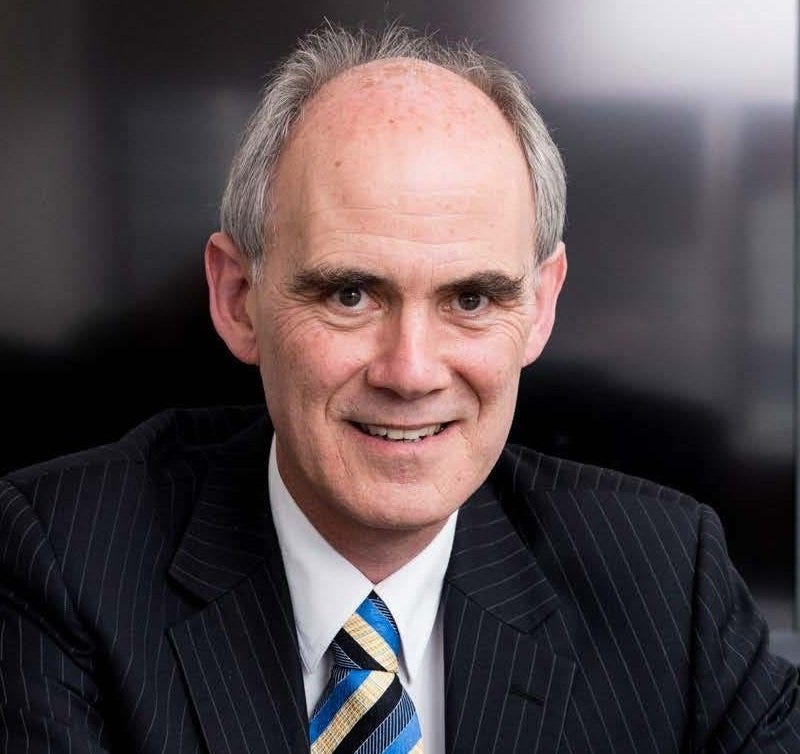
Listen to climate policy guru Professor Jonathan Boston open our series by taking a helicopter view of climate policy, then discussing the climate crisis as a super-wicked problem; adaptation and mitigation; climate change and household insurance; large scale property and regional insurance; “politics is the art of the possible” - political will and climate policy; lack of scientific advice in New Zealand parliament; and a wish for climate policy in election manifestos.
See further above for other ways to listen.
“When Petit got out of hospital, he learned that his horse had been sent for incineration by the town hall. He feared crucial evidence might be lost. Yet as it happened, the incineration service was on strike that day. Petit got the horse’s body back and arranged the autopsy privately. The results changed everything. The horse’s lungs contained lethal amounts of hydrogen sulphide.” The Guardian in a long read discussing obstruction to due process on France’s seaweed problem.
The same only different: familiar nitrogen plot, different actors
The beaches of Brittany have endured decades of toxic hydrogen sulphide gas from rotting seaweed, producing illness, deaths, and ecosystem collapse. The main cause? Excessive nitrate run off from intensive agriculture. The families of victims and the professionals that understood what was actually happening were systemically blocked or undermined by politicians, officialdom, and vested interests. In an insightful long-read piece, The Guardian unpicks the sad story.
If you read the story and then listen to our Front-footing the Future interview with Dr Mike Joy (next up) you’ll find alarming parallels between the Brittany Beaches and the Canterbury Plains. For toxic gas from seaweed in France read contaminated drinking water in NZ; for hydrogen sulphide poisoning in France read colorectal cancer in Canterbury; for the pig industry in France read the dairy industry here.
For “What lies behind this explosion of seaweed are the high levels of nitrates in the water, which come from industrial farming’s intensive use of synthetic fertilisers…” read “What lies behind this explosion of substandard water are the high levels of nitrates in the water, which come from industrial farming’s intensive use of synthetic fertilisers…”
For “Before the 1950s, farms in Brittany were small, crisscrossed with hedgerows and dotted with apple trees. … the orchards and hedgerows were chopped down, the farms were consolidated and mechanised.” read “ Before the 1990s…shelter belts…”
For “The only way to make a difference would be to shift to a less intensive system of livestock production,” read “The only way to make a difference would be to shift to a less intensive system of milk production.”
For background, check out “How nitrogen fertilizers changed the food system. Part 1” .

An important, wide-ranging book from Kiwis In Climate
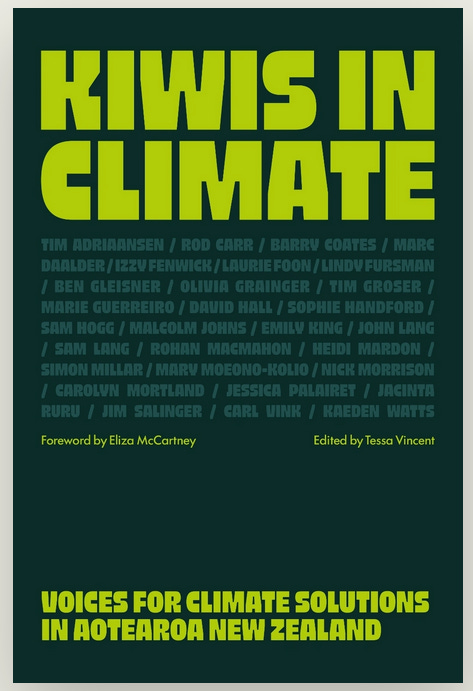
Kiwis in Climate, KIC, have featured before in CM. Founded by climate mover and shaker John Lang (John will be a guest on Front-footing the Future), and with hundreds of members around the world, KIC recently released their milestone book “Kiwis in Climate,” featuring 23 chapters by different New Zealanders active in the climate space. It, appropriately, covers a huge sweep of perspectives, from the role of youth to NZ’s significant part in setting up the Paris Agreement, and from “impossible economics” to a vision for future-proof food, all combining into a chapter structure that makes it easy to read, if not “an easy read.”
“Kiwis in Climate” should be on every Kiwi’s bookshelf. You can order it here .
“The new science, pretty much every time, seems to be coming in worse - things look more dire than we thought.” Climate scientist and former IPCC lead author and Climate Change Commissioner, Professor James Renwick updating climate science.
Front-footing the Future: full interview with Professor James Renwick,
James brings his wide experience to offer us a climate science update, insights on Antarctic sea ice, deep ocean circulation, methane, the “super El Nino” and more.
See further above for other ways to listen.
The Minister of Finance earns herself a Goon Gong
Nicola Willis has run the finances of a government that damaged or negated almost every people-positive and climate-positive long-term initiative it could get its hands on (think social cohesion; think the independence of the judiciary; think honouring Te Tiriti; think effective research institutions; think science-based climate initiatives; think cross-party agreement; think reducing income inequality; think evidence-based educational policy; think environmental protection; think visionary urban design; think…). Yet on budget day she would have us believe her when she says “It’s my responsibility to be careful and prudent now to protect New Zealand’s future.”
Like the Goons getaway car, Minister, you would have us believe you are heading one way when your track record substantiates the opposite. Here’s your Goons Gong:

Watch this space! Advice on what the government should be doing
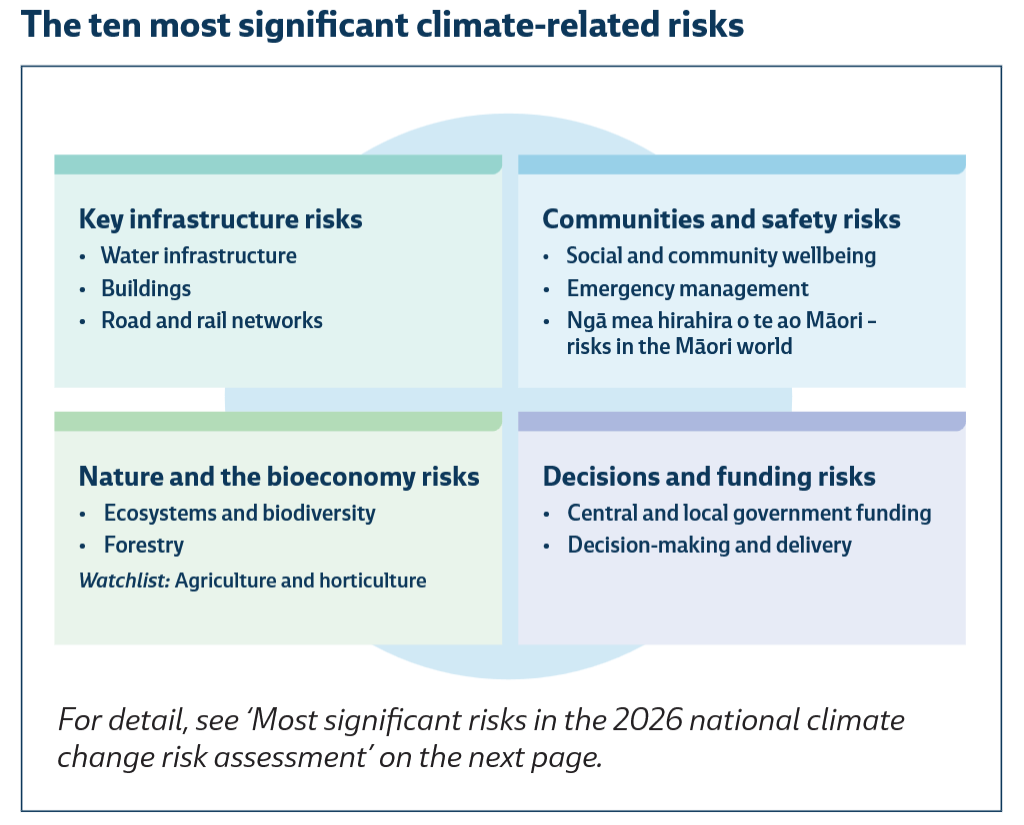
The Climate Change Commission has just released its National Climate Change Risk Assessment, with links to reports, graphics, and explainers here, including a 3-page summary, here . “The most significant risks are the climate-related risk areas where focused action in the Government’s next adaptation plan can make the biggest difference.” That plan is due by May 2028. But we won’t need to wait that long for the CCC’s assessment of the effectiveness of the last adaptation plan, due August this year. I’m not expecting a joyful read.
Here’s a table of key risks taken from from the new summary.

Give way to buses whenever you can! It’s one of the simplest climate actions you can take. Letting buses out helps them run efficiently, which means everyone on the bus gets there quicker, the buses become more attractive, encouraging more people out of cars and into buses, leaving the rest of the traffic flowing more smoothly, with lower costs, saved time, lower emissions, and easier parking. How cool is that?!
“University education, in particular, has the potential to make people more effective (planetary) vandals…” Robert Stratford, Elena Louverdis, and Mike Joy writing for Cambridge University Press (hear a full interview with Mike Joy in the next CM).
A quest for “Anthropocene Intelligence” in university education.
In a serious, and seriously introspective, paper published by Cambridge University Press, authors Robert Stratford, Elena Louverdis, and Mike Joy discuss the disconnect between current university education and the needs both of their students and the planet. The paper’s title, “From Miserable Pedagogies to Anthropocene Intelligence for Universities in the Meta-Crisis,” points to both the problem and the solution, and to the “academic speak” nature of the discussion.
Addressing a wide sweep of issues, such as the mental well-being of students as well as their knowledge base, the paper doesn’t dismiss current tertiary study per se but does highlight the need for a quantum shift and not just tinkering with present curricula. In particular, there is a stated need for a strongly integrative and holistic approach, and for an openness to dimensions outside traditional academia, such as to indigenous, spiritual, and emotional dimensions.
Well worth braving academic language to engage with this is important discussion.
But you won’t have to brave academic language to listen to Mike Joy’s articulate explanations in the Front-footing the Future series (he’s on from 8th June).
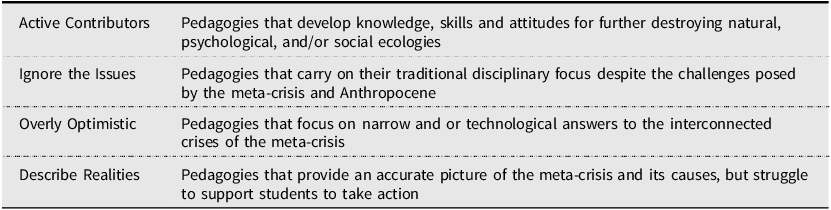
“The description of miserable pedagogies above emphasises the ways in which mainstream university education is part of the meta-crisis — through a continuation of the same tendencies in Western thinking that helped create the Anthropocene.” Stratford, Louverdis, and Joy at Cambridge University Press