
Climate Matters 151
Changing up a gear on climate policy. Get ready to buckle up!

Apologies for CM 151 being so late, which makes it seem a paradox when I say we’re changing up a gear on climate policy. Starting 25th May, and until NZ’s November election I will be conducting weekly conversations with an array of experts on the theme “Front-footing the Future: getting climate policy fit for purpose.”
Full audios will be posted here on Substack, and on Spotify, and condensed versions will go out on our weekly Climate Matters radio shows across most of the South Island and the lower North Island.
For our international readers, I hope you will find plenty of expert insights that have relevance to wherever you are. I’d welcome feedback on that or any other aspect.
I’m still getting my head round how best to weave normal content with the interviews, but CM on Substack will stay fortnightly, with two interviews posted each issue.
To give you a feel for what’s coming, the current schedule of guest interviews is at the end of this CM. It will be updated as other details are firmed up.
We’re paddling this waka as we build it, so kindly forgive progressive adjustments!
You’ll also find see below we’re also introducing the “Goons Gong” for politicians wanting us to think they’re doing one thing while intending to something different.
Okay! On with the show. Here’s what you’ll find in CM 151.
Make 90 quality minutes and listen to this!
What “Off scale high” weather might look like - April rain in Wellington.
A book of its time: “Insuring the Future”
A quiz
Prime Minister, here’s more “dumb stuff” you shouldn’t be doing
And your Freudian slip, PM, that (almost) flew under the radar
Being hit between the eyes with “Net Zero”
From the “Can you believe it?” file: A new weather word
Mind-boggling: an overabundance of the most abundant gas
Clear the Air podcasts on NZ Trucking Media
Front-footing the Future: schedule to date
Make 90 quality minutes and listen to this!
I’ve often sung the praises of Nate Hagens and his stellar guests. I have rarely been as blown away as this very recent discussion with guru of everything, Tad Patzek. I’ve listened twice and am trying to find the time for a third. If you find it heavy, try to hang in there, and if it’s still too challenging, skip to the last 30 minutes or so.
Off scale high: a taste of weather coming down the pipeline
As well as intensifying severe weather generally, an emergent feature of extreme rainfall is highly localised concentrations, with the term “river of rain” becoming increasingly familiar. In April, parts of Wellington had “normal” heavy rain while others were slammed with astonishing downpours - “extreme even by tropical standards” wrote climate scientist Professor James Renwick . (BTW James will be our second Front-footing the Future guest.)
This remarkable chart of rainfall intensity tells the story. (Check out the top RH corner).
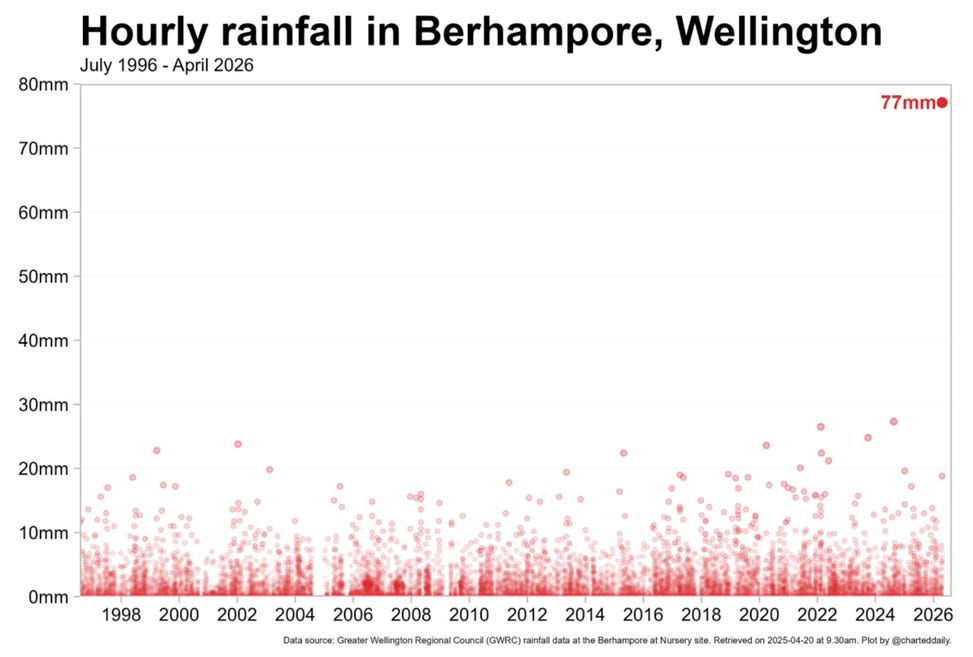
“But the most damaging rainfall often depends on processes playing out over just a few kilometres, or even less,” wrote James Renwick, “where small variations in temperature, moisture, and wind can determine whether one place is inundated while another escapes relatively lightly. In Wellington’s case, such fine-scale dynamics made all the difference.”
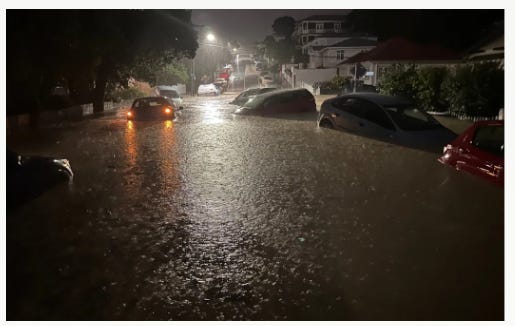
This dramatic photo by John Morrison was sent to me by Professor of Public Policy, Jonathan Boston, who wrote . “12 cars written off and 4-5 houses damaged — that was just our street!”
Which leads to a book of its time: “Insuring the Future”
As if orchestrated to coincide with Wellington’s extreme weather, (or Front-footing the Future!) Jonathan Boston’s authoritative new book “Insuring the Future” is due to be published on 11th June. (More details here .)
Readers of CM will recall us reporting on 2 million American homes becoming uninsurable last year, and on Allianz director Gunther Thallinger warning of regional economies collapsing when insurance retreats. “Markets will reprice, rapidly and brutally,” he wrote. “This is what a climate-driven market failure looks like.” In that context the book couldn’t be more timely.
Anyone who has read or heard Professor Boston’s lucid explanations won’t be surprised the jacket blurb says “In this clear-eyed work, public policy expert Jonathan Boston tackles one of the defining policy challenges of climate change: how can residential property insurance remain accessible and affordable as climate-intensified risks escalate?”

You also won’t be surprised that I’m delighted that Jonathan is front-footing our Front-footing the Future series. Who better to open a discussion on “getting climate policy fit for purpose” than a Professor of Public Policy?! From 25th May.
Quiz question:
What does kokushobi mean and what is it’s climate significance? (Psst - a clue: it’s a new word that has just been introduced to the Japanese language. )
Prime Minister, here’s more “dumb stuff” you shouldn’t be doing
Dear PM, you told RNZ “Make sure we’re not doing dumb stuff, for example, building back into flood plains.” Allow me to quickly offer you a few more for your list of very recent “dumb stuff” you shouldn’t be doing:
Telling the OECD their warnings about the LNG terminal increasing fossil fuel dependency are “a load of rubbish” . (More on the OECD report here.)
Trying to give give business “certainty” by trampling over the judiciary.
Talking out of both sides of your mouth, asking “So over time, how do we get much more knowledge data so that we can actually strengthen New Zealand and make it more resilient ?” (here) while slashing research funding, bypassing the Climate Change Commission (see CM methane special); making climate impacts worse (see CM join the dots special); and loads more.
I think that last item is worth another Goons Gong for you, PM, for pretending your interested in “much more knowledge data” when your term has been characterised by trying to shut down or bypass the very sources of such knowledge data.

And your Freudian slip, PM, that (almost) flew under the radar
Yes, at 3m 40s into this piece on Stuff , you told viewers it was about “being accountable for what we’re doing as a government about driving climate change.” (TBH, PM, it was another both sides of your mouth performance - even after listening several times, it was hard to be sure I had heard you correctly.)
Given that your government is doing far, far too much about driving climate change, how about holding yourself accountable, PM, and resigning? I suspect you won’t as I can’t imagine you’ve finished trying to drive climate change further the wrong way.
So here’s Goon Gong number 2. Two in one CM - go you, PM!
Being hit between the eyes with “Net Zero”
Do listen to Climate Scientist Kevin Andersen call out our preoccupation with “Net Zero.” A full-on ninety minutes of joining the dots in unexpected ways (and unjoining other dots too.) “When you believe your own delusion it becomes very easy to con others.”
Where can we hear “Clear the Air”? Response to a reader inquiry
Readers may recall I have a long connection with the NZ trucking sector and have written in various forms for NZ Trucking Media, including the monthly “Clear the Air” column. That column is also the basis of a monthly “mini-pod” where NZTM director Dave McCoid and I use it as a prompt to “discuss the climate and environmental issues of the day, as they should be discussed – respectfully!”
Dave and I take both pride and sorrow from the comment of a Swedish guru on transport media who told Dave we were the only people he had found in the world holding this sort of discussion. Be great to learn of other cases. You can check it out here if you wish. (24 minutes for this episode).
From the “Can you believe it?” file: A new weather word
Japan's Meteorological Agency has a tradition of using particular words to signify specific forecast temperatures, such as 25 degrees, 30 degrees, etc. After last year’s hottest summer on record, they have just introduced the term “Kokushobi” for predicted temperatures above 40 degrees. Derived from koku - meaning harsh or cruel - it translates to "cruelly hot" or "brutally hot." (Last summer they had ten days over 40 degrees C)Check the BBC for more .
Mind-boggling: an overabundance of the most abundant gas
Check out the Sankey diagrams for changes in nitrogen use over 50 years, read the text after it for where it ends up being used (in the US), factor in that, globally, nitrous oxide is an even more serious greenhouse gas than methane, and then figure out when we lost our sanity and how we might recover it.
If you want a deeper dive, check out this explainer and this one.
![Figure 4: Nitrogen (N) flows in the global agri-food system in 1961 and 2013, following the Generalized Representation of Agri-Food Systems [6,7]. The width of arrows correspond to the size of annual flows. Numbers are in million metric tonnes per year (Mt N/year). Arrows pointing out from agricultural land, livestock, and human population represent N losses including dinitrogen (N2). Diagram adapted from [7] in collaboration with Luis Lassaletta.](https://substackcdn.com/image/fetch/$s_!XZ1b!,f_auto,q_auto:good,fl_progressive:steep/https%3A%2F%2Fsubstack-post-media.s3.amazonaws.com%2Fpublic%2Fimages%2F8566f750-9f95-4d89-8852-b395e6b067eb_508x671.png "Figure 4: Nitrogen (N) flows in the global agri-food system in 1961 and 2013, following the Generalized Representation of Agri-Food Systems [6,7]. The width of arrows correspond to the size of annual flows. Numbers are in million metric tonnes per year (Mt N/year). Arrows pointing out from agricultural land, livestock, and human population represent N losses including dinitrogen (N2). Diagram adapted from [7] in collaboration with Luis Lassaletta.")
“Total cropland in the United States in 2024 was 328 million acres. Over half of that cropland was used to produce exactly two crops, field corn and soybeans. Neither of these crops is produced primarily as food for humans. Approximately 6% to 7% of global soybean production is eaten by humans annually. In the United States, less than 2% of field corn, our largest single crop, is eaten by humans annually.”
Front-footing the future series
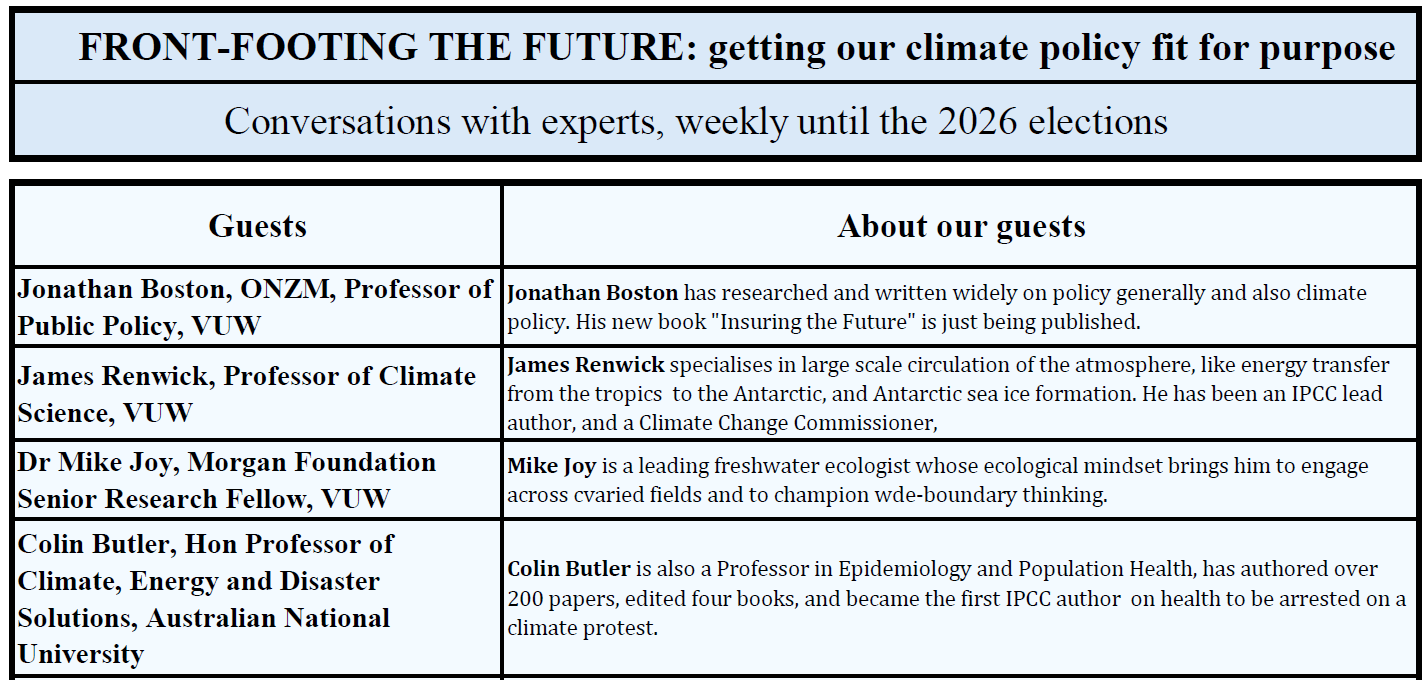
We’re on the cusp of launching our interview series. Here are the first four (to be released weekly, starting Monday 25th May). Future CMs will include interview audios and links. Further below you can download the full schedule (to date - a few responses are still awaited. It will be progressively updated)

Lindsay. A good, succinct, CM 151.
Congratulations on your Front-Footing The Future Guest list - well done you!
Can I, and others in your CM list, expect an email on the release dates and timing of each interview, and the channels?
Cheers Woody